
Nearly 1,000 years after it was made, the Bayeux Tapestry is set to return to England for the first time.
This world-famous tapestry depicts events leading up to the Battle of Hastings and the Norman conquest in 1066, and is an incredible 70 metres long.
The tapestry is being loaned to the British Museum between September 2026 and July 2027. Its permanent home is the Bayeux Tapestry Museum in Normandy, France, but as the museum is closed for renovations it has made this historic loan to the UK.
With this in mind, discover five other fascinating medieval monuments you can visit or view in the UK.
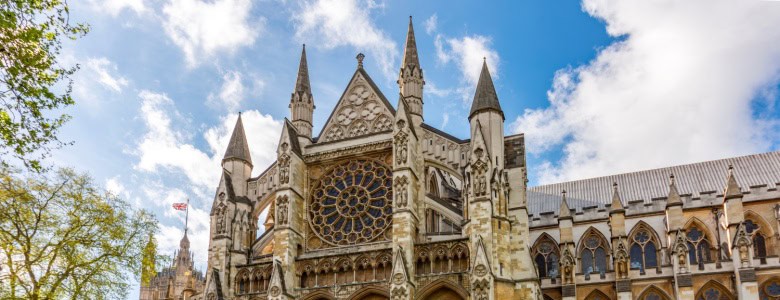
1. Westminster Abbey, central London
One of the stalwarts of the London skyline, Westminster Abbey is one of the most iconic and famous medieval sites in the UK.
It was first constructed in the 11th century by Saxon king Edward the Confessor. Since then, it has been the location for many pivotal historic events, including the coronations of William the Conqueror, Elizabeth II, and Charles III.
The Tomb of the Unknown Warrior is one of the most moving sights in the Abbey. It holds the remains of an unidentified British soldier from the first world war, and represents all fallen personnel with no known grave.
The Abbey is also the final resting place of a number of prominent figures, including Elizabeth I, Mary, Queen of Scots, Charles Darwin, and Geoffrey Chaucer.
Opening times are 9.30 am – 3.30 pm (Monday to Friday) and 9.30 am – 3 pm (Saturday). The Abbey is closed to visitors on Sunday as it holds services.
Pre-booking is recommended.
2. Fountains Abbey and Studley Royal, North Yorkshire
This site is teeming with rich history. Founded back in 1132 by a group of devout monks, it quickly became one of the wealthiest Cistercian monasteries in England. However, it was raided by Henry VIII during the Dissolution of the Monasteries, taking it from glory to ruin.
Later, in the 18th century, Fountains Abbey was incorporated into the landscape of Studley Royal, and was recognised as a World Heritage Site in 1986.
The ruins are perfect for history buffs to explore, with imposing columns, vaulted ceilings. and a magnificent tower. Plus, you can wander around the ornamental water garden and see over 300 deer who call the parkland home.
Opening times are 9.30 am – 4.30 pm.
3. Caerlaverock Castle, Dumfries and Galloway
This unique, triangular water-filled moat castle was built in the 13th century, on the border between Scotland and England. This strategic position led to it being besieged many times, most famously by Edward I and his English army of 3,000 men.
Its unique geometry also offered strategic advantages, and it is now a place of fascination for history lovers.
As well as Caerlaverock itself, you can find the foundations of the “Old Castle”, dating back to the 13th century, at the end of a short nature trail.
Open daily from 9:30 am – 5 pm (April to September) and 10 am – 4 pm (October to March).
4. Caerphilly Castle, South Wales
A massive feat of architecture, Caerphilly Castle spans 30 acres, making it the largest castle in Wales and the second largest in the UK. It was built in the 13th century by Gilbert de Clare.
Its “walls within walls” concept offered a strategic defence position, while its water defences included dams and artificial lakes to create barriers against attackers. Meanwhile, its famous “leaning tower” tilts even more sharply than the Leaning Tower of Pisa, and is a great visitor attraction.
Open 9.30 am – 6 pm (1 July to 31 August), with slightly shorter opening times during the rest of the year.
5. Dunluce Castle, County Antrim
Picturesque and romantic, Dunluce Castle is accessible via a bridge connecting it to the mainland. Built by feuding clans from the 14th century, it was an epicentre of frequent and fierce regional power struggles.
Its dramatic clifftop location is both beautiful and imposing, and its history no less so. In the 17th century, part of its kitchen collapsed into the raging sea during a storm, taking the servants with it. Plus, it sits above the “Mermaid’s Cave”, a large cave at which ships could anchor, or supplies could be smuggled in.
Open 9.30 am – 5pm (1 March to 31 October).